
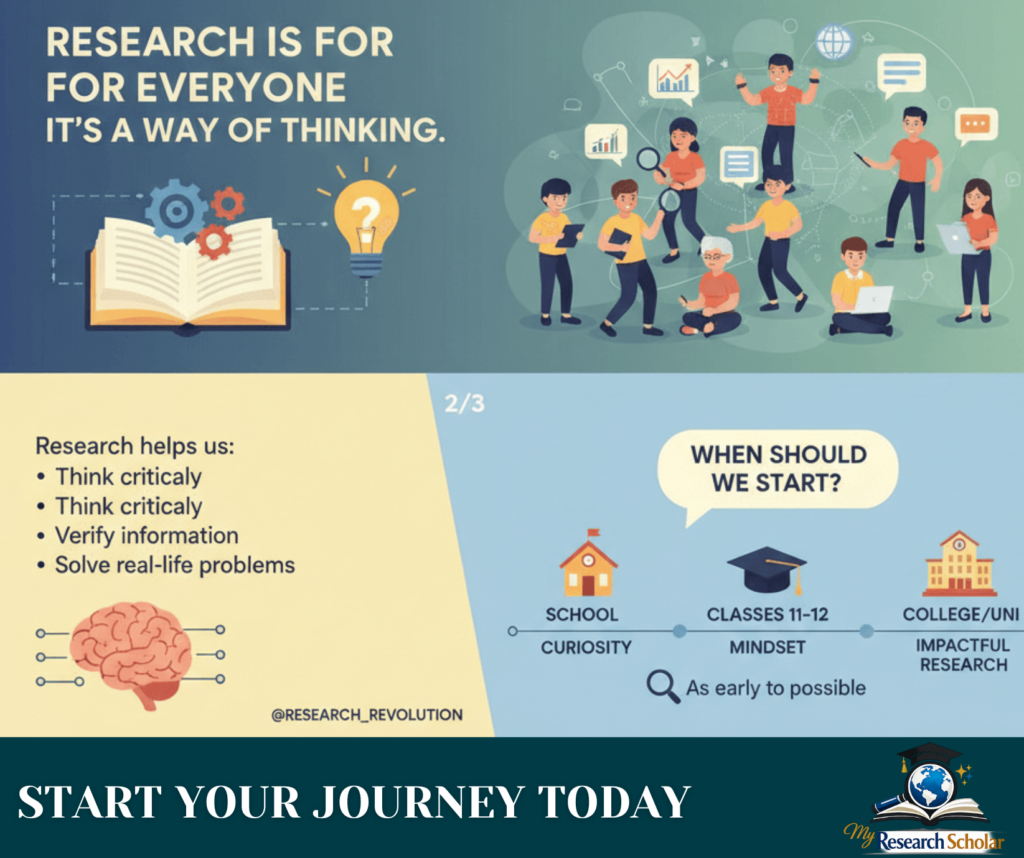
Research is a structured effort to find answers. It uses careful methods to collect evidence, analyze it, and draw conclusions that are as objective and verifiable as possible.
Goals of Research
- Discover new knowledge
- Test hypotheses or theories
- Solve practical problems
- Inform policy or decisions
- Improve products, services, or processes
Types of Research
- Basic (Pure) Research
- Focus: Expand knowledge and understanding.
- Example: Studying how memory works in the brain.
- Applied Research
- Focus: Solve practical problems or develop applications.
- Example: Designing a drug to treat a disease.
- Descriptive Research
- Focus: Describe characteristics or functions.
- Example: Surveying customer demographics.
- Analytical/Explanatory Research
- Focus: Explain why or how something happens.
- Example: Investigating causes of climate change.
- Exploratory Research
- Focus: Investigate an area where little is known.
- Example: Interviews to generate hypotheses.
- Evaluative Research
- Focus: Assess the effectiveness of a program or product.
- Example: Measuring outcomes of an education intervention.
Research Methods — Qualitative vs Quantitative
- Quantitative Methods
- Use numbers, statistics, and structured instruments (surveys, experiments).
- Strength: Precise measurement, generalizability with proper sampling.
- Example: A poll that quantifies user satisfaction on a 1–10 scale.
- Qualitative Methods
- Use words, observations, interviews, and themes.
- Strength: Rich, in-depth understanding of behaviors and meanings.
- Example: Focus groups exploring why users prefer one design.
- Mixed Methods
- Combine both to get broader insights and validation.
The Research Process — Step by Step
- Identify the Topic / Problem
- Start with a clear, focused question. Narrow broad ideas into specific, researchable questions.
- Conduct a Literature Review
- Read existing studies to learn what’s known, find gaps, and refine your question.
- Formulate a Research Question or Hypothesis
- Example research question: “Does a 10-minute mindfulness practice reduce student test anxiety?”
- Hypothesis: “Students who practice mindfulness for 10 minutes before tests will report lower anxiety scores.”
- Choose Methodology
- Decide on qualitative, quantitative, or mixed methods; select tools (survey, experiment, interview, observation).
- Design the Study
- Plan sampling, instruments, procedures, and any controls. Consider ethics and consent.
- Collect Data
- Gather information using your chosen tools. Ensure accuracy and consistency.
- Analyze Data
- Quantitative: statistical tests, graphs, significance.
- Qualitative: coding, thematic analysis, pattern identification.
- Interpret Results
- Relate findings back to your question and the literature. Discuss implications and limitations.
- Report & Share
- Write a clear report, paper, or blog post. Use visuals, citations, and plain-language summaries.
- Reflect & Plan Next Steps
- Identify limitations, suggest future research, or apply findings to practice.
Common Research Tools & Resources
- Academic databases: Google Scholar, PubMed, JSTOR
- Survey tools: Google Forms, Typeform, SurveyMonkey
- Statistical software: Excel, R, SPSS, Python (pandas, scipy)
- Qualitative tools: NVivo, manual coding, Dedoose
- Reference managers: Zotero, Mendeley, EndNote
Ethics in Research
- Obtain informed consent from participants.
- Ensure privacy and confidentiality.
- Avoid plagiarism — cite sources.
- Be transparent about methods and conflicts of interest.
- Seek approval from ethics boards when required.
Common Pitfalls & How to Avoid Them
- Poorly defined questions → spend more time refining the question.
- Small or biased samples → plan proper sampling.
- Ignoring existing literature → perform a thorough review.
- Overgeneralizing results → be clear about limitations.
- Confirmation bias → use objective measures and peer review.
Tips for Beginners
- Start small: a focused, manageable question is better than an overly broad one.
- Keep a research journal to track ideas, sources, and progress.
- Join study groups or online forums for feedback.
- Learn basic stats (mean, median, significance) and a reference manager.
- Read research papers in your field to learn structure and style.
Example: Quick Beginner Project
- Topic: Does listening to instrumental music improve concentration while studying?
- Steps:
- Define question and variables (study time, concentration score).
- Run a small experiment with two groups: music vs silence.
- Use a short standardized concentration test.
- Analyze average scores and compare.
- Report findings and limitations.
Research transforms curiosity into reliable knowledge. With a clear question, sound methods, and ethical practice, even beginners can produce useful, trustworthy results. Start small, stay curious, and build your skills step by step.